Cultivating Mindfulness Part 2: Resources
Elizabeth Heller’s mission is to empower children and teens to self-manage emotional and physical wellness with the evidence-based tools of breathwork, body movement, and journaling. Elizabeth recently shared resources for using mindfulness in our families and with our children.
You have shared a lot about mindfulness, movement, and journaling. What resources can you recommend?
First, you are your greatest resource. You know more than you think you do! Using tools to connect with your inner knowledge is the most important resource. You can do this with a simple practice of pausing to notice any body sensation or feeling, without judgment and taking three to five breaths. Even one breath makes a difference.
Noticing is really about listening and paying attention. Researchers (and anyone who uses it) know that social media is a practice of distraction and disconnection. I believe children need to find their inner creativity and imagination long before they are bombarded with images of other people’s ideas and truths. We can learn to count, know colors, and learn the seasons and the alphabet without screen time.
I suggest trying different family activities like:
- exploring the library by making a ‘treasure hunt’ for information on whales, or basketball, or the moon
- teaching kids to read paper maps and then drive places without the GPS (the destination could be a place for a picnic, mini-golf, or a museum)
- walking outside often and inside when the weather is uncooperative
- breathing together before a meal or on the way to school
- doing a one-word check-in before transitions or after to notice and share what you are feeling in the moment,
- and, of course, reading with your kids or as a family.
It’s really about mindful attention, connection, and limiting distractions in order to enhance the connection to the self, others, and the world.
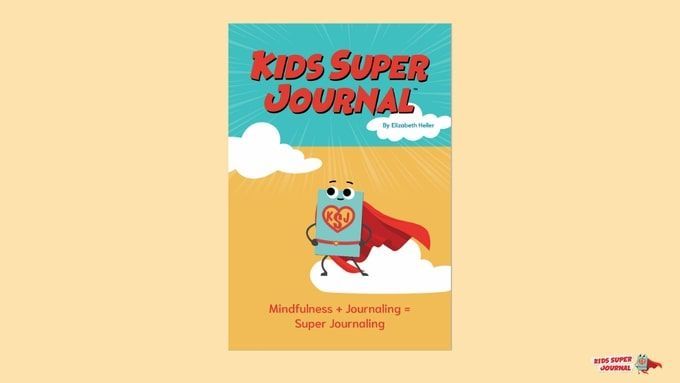
Having a journaling practice also helps, so using the Kids Super Journal or Teen Super Journal is an effective and fun way for kids and caregivers to practice mindfulness in minutes a day in their own creative way. Any guide that encourages self-exploration with pen and paper is a great way to explore who we are day-to-day because we are always changing.
Tell us more about the Super Journals.
The Kids Super Journal and Teen Super Journal are 70-day activity books that empower kids and teens to self-manage their emotional and physical wellness with the evidence-based tools of breathing, moving, and journaling. Each of the seven chapters has a “Mindfulness Menu” with fun and simple breath practices and body shapes for that chapter. Each chapter has 10 journal days based on a theme like Building Strength, Feelings Are Like the Weather, Love, and Gratitude.
Each journal day includes a breath and movement option, a feelings report and body sensation check-in, a fun journal prompt, and a positive activity. The journals are designed to help kids and teens create a mindfulness habit in just a few minutes a day. And with tools kids can use immediately and for a lifetime.
Breathing, moving, and journaling require no special training or equipment and are effective right out of the box. Kids and teens can use the books on their own with no special training or adult help necessary. That makes them a wonderful tool for home use and use in schools and mental health organizations and they are being used more and more in all those settings.
I have heard from dozens of adults who have used the Kids Super Journal for themselves and love it. Men and women. And the most common thing they say when they read about the tools in the Super Journals is ‘Oh, is this mindfulness? I can do this.’ The format works for anyone! Simplicity and consistency are key to creating a wellness habit. The Super Journals help kids and teens (and adults) do that.
Also, it’s important to remember that the key to mindful journaling is to simply write down whatever you notice at that moment. Spelling, grammar, punctuation, and pretty prose do not matter. You don’t even have to answer the prompt if you want to write or draw about something else. There is no right or wrong way to journal and there should also be no pressure to share. Journaling can only be effective if we feel free to express ourselves without anyone else reading or seeing what we journaled.

Are there ways families can have this kind of experience together?
In addition to breathing together and physical activity together, creating a journal jar as a family is also a great practice and as an option for kids to choose on their own.
To create a journal jar, find a big glass jar or jug. As a family, everyone writes down journal questions on slips of paper. It helps to choose a theme and include questions about feelings. Then put the papers in the jar.
Every day at a designated time (like before or after dinner) have kids take turns choosing a question from the jar. Put a timer on for five minutes and everyone (including adults) can journal their response. Drawing counts as journaling so small children can also participate.
Keep the Journal Jar in an accessible place along with markers and paper so kids and teens can use it whenever they want to. You can also read a question aloud and share your thoughts together as a family.
Can you give some examples of how people have implemented these practices?
Older students have shared that they wished they could have learned about mindfulness when they were younger because they thought that would have really helped them have a better high school experience.
I’ve also had some teachers decide to use the Super Journals for themselves. One music teacher said, “It was luxurious to spend those five minutes or so every morning with myself on those pages.”
It’s important to remember that curiosity is everything. If we start with curiosity we can say to our child, “I notice you are running in circles. I’m curious.” Start there. Then the next step is to teach our child to be curious. With this, there is a place to find a response versus a reaction and most importantly learn something in the moment by staying in connection.
We will always be in connection with other humans, so modeling is so important. We are teaching kids how to be connected and participate in the world and how to help other people do the same. This way we are setting up children to have cohesive relationships, which is the foundation of a healthy, joyful life. With breathing, moving, and journaling we are giving kids tools to self-manage their lives – their emotional lives, their physical lives, their social lives – and explore them.
What is so beautiful about humans is who we are inside. That is our uniqueness. The more we understand who that is and how to express it, the more we grow. That is what is beautiful, fun, and interesting as we move through the journey of living!
Subscribe to our Blog
You might also like