
Looking Deeper: Understanding Needs Behind Behaviors

Now that we are transitioning into the summer months, it’s a good time to take stock of some family dynamics. Usually when thinking about how things are going, we focus on children’s behaviors. Yet reflecting upon ourselves and our actions can also be a helpful first step.
First Look at Needs
Psychiatrist Rudolf Dreikurs has explored how human behavior has a purpose. Sometimes we are aware of the purpose and sometimes it is unconscious. Through his work with children, Dreikurs described how to understand behavior by first acknowledging the needs a person is trying to fulfill.
At the most basic level, we all need food, sleep, love, and protection. Certainly, if children (or adults) are starting to act out in some way, the first question to ask is if they are hungry, tired, or not feeling well. Once those basic needs are met, we can consider what else might be at play.
As humans, our need for belonging, connection, or significance is a strong force. If we don’t feel loved or accepted, we may do something (often unconsciously) to get affection or attention, maybe lash out to get even with whoever doesn't seem to be noticing these needs, or perhaps even retreat into a discouraged mode.
Understand Mistaken Goals
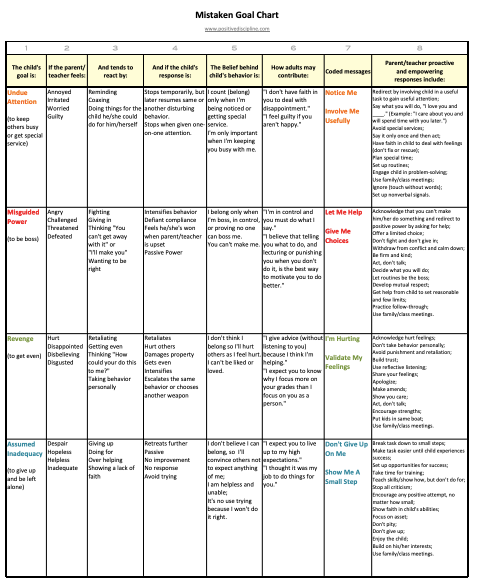
Dreikurs identified how many behaviors stem from four mistaken goals: the desire for attention, the need for power, the hunger for revenge, and the assumption of inadequacy. If our goal is attention, the coded message behind the behavior is "notice me" or "involve me usefully" If we need power, our behavior sends the message that we need meaningful ways to contribute. If we are trying to get revenge, we are communicating that we are hurting or need our feelings validated. And when we assume inadequacy by giving up or wanting to be left alone, the message behind the behavior is that we need people to believe in us and show small steps toward success.
Although Dreikurs focused on children, the principles apply to us all. When we "act out," what are we trying to communicate to those around us? First and foremost, we should check and see if our basic needs are being met. Are we taking time to breathe? Are we eating nourishing food? Are we getting substantial sleep? If we are taking care of our basic needs, we can reflect upon what else might unconsciously be motivating our actions. Do we need someone to notice our efforts? Do we feel powerful in our lives? Are we doing work that matters? Are we holding onto a grudge? Are we discouraged?
Practice Self-Acceptance
Children need the adults in their lives to peer behind their behavior, consider underlying causes, and provide empowering support. As adults, however, we often need to do this for ourselves first. At the heart of the process is self-acceptance. We need to love ourselves unconditionally and give ourselves the time and space to attend to our unconscious motivations.
One of the first acts of loving kindness we can do is take care of ourselves, notice our own needs, and patiently honor our efforts. When we are clear about our own needs, we can then be more effective in interpreting our children’s unmet or unspoken needs.
Examine the Clues
Once we have given ourselves some grace, we can better pause and notice what might be behind our children’s behavior. If we’ve considered our own unmet needs, we can have more empathy for what might be unconsciously motivating our children.
A key to this is to see what emotions we feel when our children act out in some way. The Positive Discipline approach, which is based on Dreikurs’ work, offers a helpful tool called the Mistaken Goal Chart.
When our children display some sort of bothersome or upsetting behavior, we can use this chart to hone in on three significant clues that let us know what our children actually need.
The first clue can be found in recognizing what emotions our children’s behavior brings up for us. Do we feel annoyed and irritated, angry and challenged, hurt and disappointed, or hopeless and inadequate?
The next clue is how we react to the behavior. Do we coax? Give in? Fight back? Retaliate? Give up? Try to over-help?
The third clue is how our children respond to our reactions. Do they stop temporarily but then resume the behavior? Does the behavior intensify? Is there retaliation? Or just passivity?
Peel Back the Layers
By using the Mistaken Goal Chart, we can begin to peel back the layers and start to understand what beliefs may be underlying children’s behaviors. This process helps us also look at how we may be contributing to the behavior and what the coded messages mean. Once we understand all of those pieces we can shift our responses so as to better empower our children in proactive and helpful ways.
Rather than falling into unconscious patterns this summer, let’s first consider and acknowledge our own unspoken needs and proactive ways to take care of ourselves. Then, let’s take the same compassionate approach with our children. Often, we all just need to feel a sense of belonging, connection, and significance. Here’s to creating that together this summer!
Subscribe to our Blog
You might also like