From Independence to Interdependence

Tamara Sevigny • September 5, 2022

In Montessori, we talk a lot about independence. However, one of the lesser known or understood aspects of Montessori is that independence isn’t the end goal.


As humans, we are each wonderful, unique individuals. But we don’t exist in isolation. We live amongst other wonderful, unique individuals! In order to effectively live in community with other people, though, we need to be able to function independently. Said another way, before we can offer help to others or make ourselves useful, we need to be able to meet our own needs.


How can we be independent and interdependent at the same time?


We all want to make choices for ourselves, exercise our liberty, and be responsible for our own lives. At the same time, we also want to be part of something. We are designed to be both independent and be in community. These two needs are not mutually exclusive, but in fact, operate in relationship to each other. We have an innate desire to be autonomous and to belong.


When we develop the ability to act for ourselves, make choices, control ourselves, and accept responsibility, we are able to be functioning, contributing members of society. We can see what needs doing and do it because we have the skills to do so. We can work with others to create solutions or produce goods and services. We can be part of a community by acting and taking responsibility for our actions, each able to contribute because we all have the skills to do so.


What does this have to do with children and Montessori education?


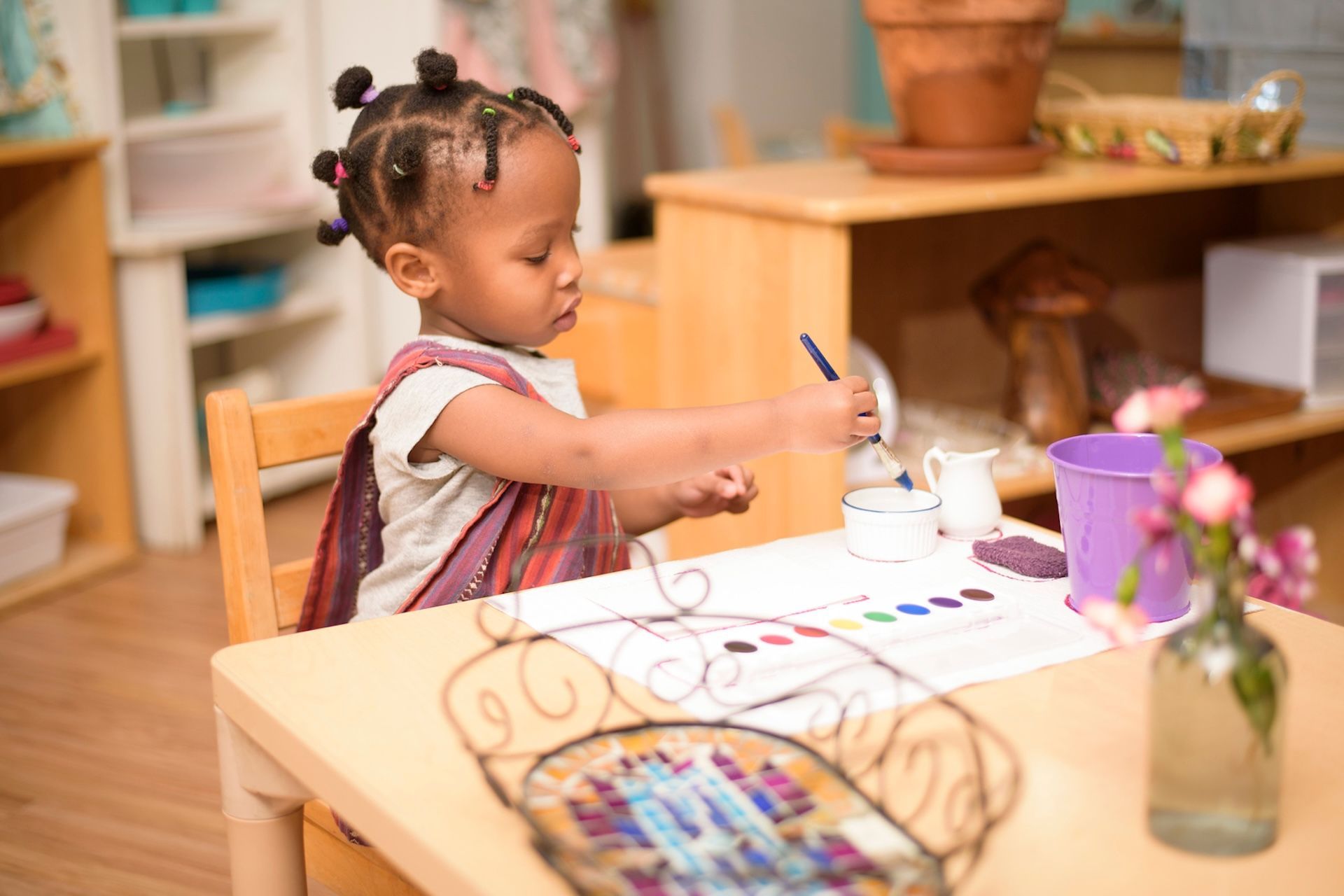
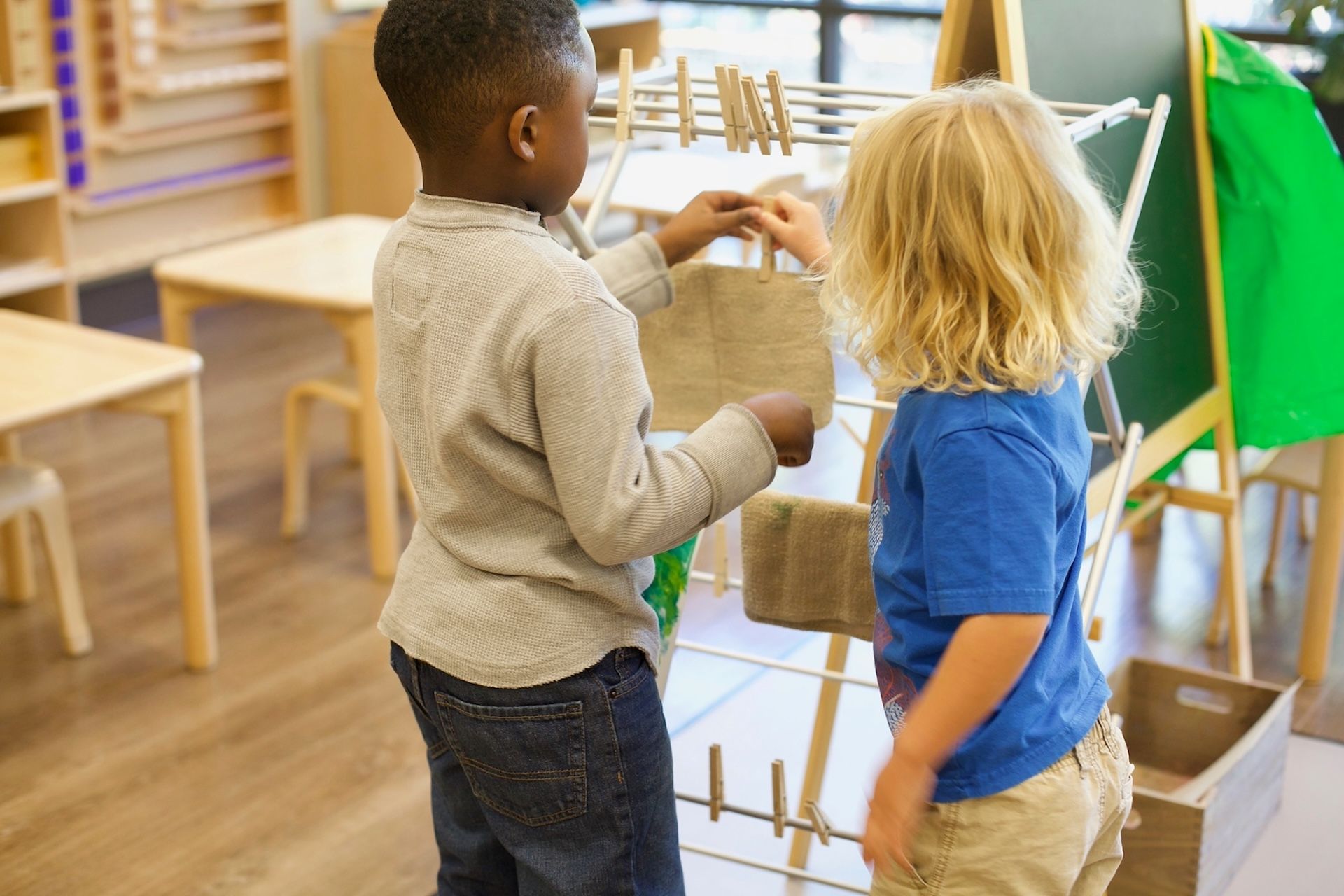
From a very young age, children are trying to exert control over their lives. Children are trying to gain functional independence from birth to about age three. In Montessori classrooms, we offer all sorts of opportunities for young children to develop skills that help them take care of their basic needs. But we don’t stop there! We also provide so many ways children can care for others and for their surroundings.


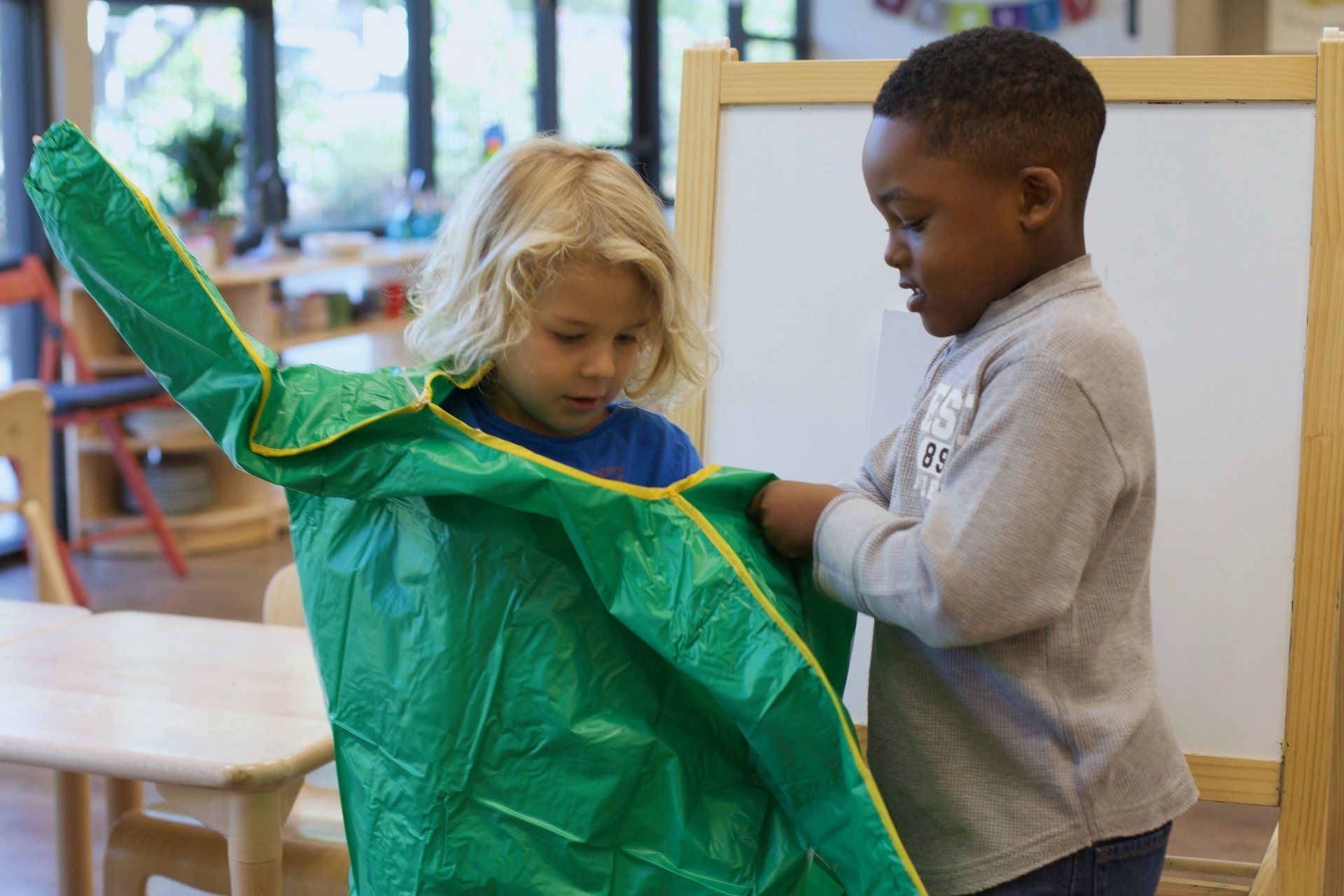
Once children have mastered pouring from one pitcher to another, they are able to pour water into a vase and arrange flowers to beautify the classroom. After they learn how to sweep, they are quick to notice a spill and rush to get the dustpan and dust brush so they can help. When someone is struggling to zip their jacket, they take pride in sharing their newfound skill in service to someone else’s needs.


As children move into the elementary years, this service to others often takes on a slightly different form, in part because elementary-age children are developing their intellectual independence. Thus, their contribution often involves applying these newfound intellectual skills. They might notice a classmate struggling to figure out the steps in a math problem and offer support. Or when friends are in conflict, they might provide some mediation to help each party listen to the others’ perspective.


In adolescence, young adults are ready to work toward being socially and economically independent. They want to figure out their place in society, grapple with real problems, and contribute in a useful way. Thus, Montessori adolescent programs offer teens the chance to develop and feel secure in their own abilities while also collaborating in real and meaningful social endeavors. In the process of running a small business, for example, adolescents are applying their intellectual skills from marketing to mathematics, while also navigating how to communicate with customers and collaborate with classmates.


Why is this important?


As humans, we want to achieve independence and belonging. Being independent is about learning the skills to be able to contribute in a meaningful way. All the little conquests of independence–throughout each age and stage of development–matter! When our infant reaches to grasp an object, our two-year-old demands to put their shirt on themselves, our eight-year-old argues about just and fair rules of a game, or our adolescent insists they can solve a problem with their peers, we can remember that these acts of independence are laying a foundation for our children to become part of an interdependent, harmonious society.


Independence is just a step. Interdependence is the ultimate goal.

Subscribe to our Blog

You might also like
By Danielle Giordano February 10, 2026
When we pick up our children from school, it’s almost automatic to ask, “How was your day?” And just as automatically, the answers tend to fall flat: fine, good, okay, or sometimes nothing at all. As adults, we can probably relate. When someone asks about our day, we don’t always feel like revisiting every detail, especially before we’ve had a chance to rest or reset. For children, this challenge is even greater. In Montessori environments, children are immersed in experiences that are rich, complex, and often difficult to put into words. How does a young child explain the sensorial experience of carefully carrying each cube of the Pink Tower across the room? Or describe the quiet satisfaction of discovering that ten tens create a hundred square? Or articulate the subtle social negotiations that happen during community lunch? Even for older children, language often lags behind experience. Why “How Was Your Day?” Can Feel Like Too Much As children move into the elementary years, they are also navigating peer relationships that are still very black and white. A single interaction can color their entire perception of the day. So their reports may sound overly simple: someone was mean, someone was nice, the day was bad, the day was good. But often, the issue isn’t that children don’t want to share. Instead, the timing is off. Research on children’s nervous systems helps explain why. When children walk out of school, their brains are often still in a state of high alert. Throughout the day they’ve managed noise, social expectations, concentration, corrections, and constant stimulation. Their nervous system hasn’t fully shifted out of “school mode” yet. So it helps if we remember that we aren’t greeting children in their most rational state. Those first minutes after pickup are a transition, not a conversation window. When we jump in with questions too quickly, even well-meaning ones, we may unintentionally overwhelm our children’s nervous system, which hasn’t had time to settle. Connection Before Conversation In Montessori, we place great importance on transitions. We know children need time to move from one state of being to another, whether that’s arriving at school, moving between activities, or going home at the end of the day. Instead of starting with questions, we can start with presence. When we first see our children, a warm greeting that communicates “I’m happy to see you” goes a long way. Some children need a snack. Some need quiet. Some need movement, proximity, or simply space. This is not the moment to gather information. This is the moment to re-establish connection. When families allow even 10 to 12 minutes of quiet decompression after school, through silence, music, or simply being together, children regulate more quickly. Evening stress decreases, cooperation improves, and children are more likely to talk voluntarily later on. Rather than interrogating right after school. Try coexisting. This pause is deeply respectful. When Children Are Ready to Talk Later, after your child has had time to settle back into your care, you may notice that conversation begins naturally. This is often when children share what mattered most to them, not what we might have thought to ask about. When you do open the door to conversation, gentle specificity helps. Broad questions like “How was your day?” can feel overwhelming. Instead, try comments that invite reflection without pressure: “I noticed you seemed really focused when I picked you up.” “I’m here if you want to tell me about something you worked on today.” “What felt good about today?” Just as important as the words is our availability. Putting down the phone, pausing the logistics, and showing with our body language that we are truly listening makes it safer for children to share. Listening for Timing, Not Just Content This approach applies across ages. Even adolescents benefit from what some call a “quiet landing” after school. When we honor timing, we’re less likely to walk into the emotional residue of the day and more likely to build cooperation and connection later. In Montessori, we often say: regulation comes before reflection. Children don’t need us to extract their feelings. They need us to create the conditions where feelings can land safely. Sometimes that looks like silence. Sometimes it looks like presence. And sometimes, after enough space has been given, it looks like a child finally saying exactly what mattered most. So the question isn’t just “Do I listen to what my child says?” And instead becomes: “Do I listen for when they’re ready to speak?” Curious to learn more strategies to support your child during transitions? Set up a time to come visit here in [Your Town/Location]. We love to connect! .
By Danielle Giordano February 4, 2026
The body content of your post goes here. To edit this text, click on it and delete this default text and start typing your own or paste your own from a different source.
By Danielle Giordano January 30, 2026
In Montessori elementary classrooms, we like to introduce big ideas with big stories. We offer children a sense of wonder first, sort of like an imaginative doorway, so that when they later study formulas, theorems, and proofs, they already feel connected to the human story behind them. One of these stories is The Story of How Geometry Got Its Name, an introduction to a subject that is far older than the textbooks and protractors we encounter today. In Montessori, Geometry is more than about shapes. It is about human beings solving real problems in the real world. A Problem as Old as Civilization To introduce geometry, we take children about five thousand years back in time to the ancient civilization of Egypt. This was a land shaped by the , the longest river in the world. Each year, the Nile flooded its banks as snowmelt poured down from the mountains far to the south. The Egyptians depended on this yearly flood as it left behind rich, dark silt that nourished their crops and made life possible in an otherwise harsh desert. But the flood created a challenge, too. It washed away the boundary markers that separated one farmer’s field from another. When the waters receded, no one could quite remember where their land began and ended. Arguments ensued. “This corner is mine!” And the fields needed to be measured and marked again. The First Geometers: The Rope Stretchers To solve this annual problem, the Egyptians relied on a special group of skilled workers called the Harpedonaptai, or Rope Stretchers. These were early land surveyors who used a knotted rope tied at regular intervals and three weights to create a very particular triangle. In the classroom, we invite a few children to hold a prepared rope at its large knots, forming that same triangle. As they stretch it out and lay it on the ground, many quickly recognize what the Egyptians had unknowingly created: a scalene right-angled triangle. This shape would later become central to the geometry studied by Greek mathematicians. The Rope Stretchers used this simple tool to re-establish field boundaries, set right angles, and make sure the land was measured accurately and fairly. Geometry, in its earliest form, served a deeply practical purpose. From Rope to Pyramid The Rope Stretchers’ expertise was valued far beyond the farmlands. They also helped lay out the foundations of temples, monuments, and even the Great Pyramid of Giza. The base of the Great Pyramid is a perfect square, which is an astonishing feat of measurement and design. The Pharaoh himself oversaw these measurements, but it was the Rope Stretchers who executed them. Their work represents one of humanity’s earliest recorded sciences: the careful measuring of the earth. How Geometry Got Its Name The name geometry reflects this ancient practice. It comes from two Greek words: gê — earth metron — measure Geometry literally means earth measurement. The Egyptians did not use the language of right angles, nor did they classify triangles as we do today. Their work was grounded in practical needs. They needed to solve problems, organize land, and create structures that would endure for thousands of years. Yet their discoveries influenced later thinkers like Pythagoras, who likely traveled to Egypt and learned from their methods. Over time, the simple knotted rope inspired a whole discipline devoted to understanding lines, angles, shapes, and the relationships between them. Why We Tell This Story in Montessori When Montessori children hear this story, something important happens. Geometry becomes more than a set of rules or vocabulary words. It becomes a human endeavor born from curiosity, necessity, and ingenuity. This is the heart of Montessori’s cosmic education: helping children see knowledge not as isolated subjects, but as gifts from generations before them. When children pick up a ruler, explore angles with a protractor, or classify triangles in the classroom, they are continuing a legacy that began with those early Rope Stretchers on the banks of the Nile. Through story, children feel connected to the people who shaped our world and to the problems that inspired great ideas. Schedule a tour today to see how geometry becomes meaningful, purposeful, and alive for our children here in Old Saybrook, CT.
More Posts