Walking on the Line
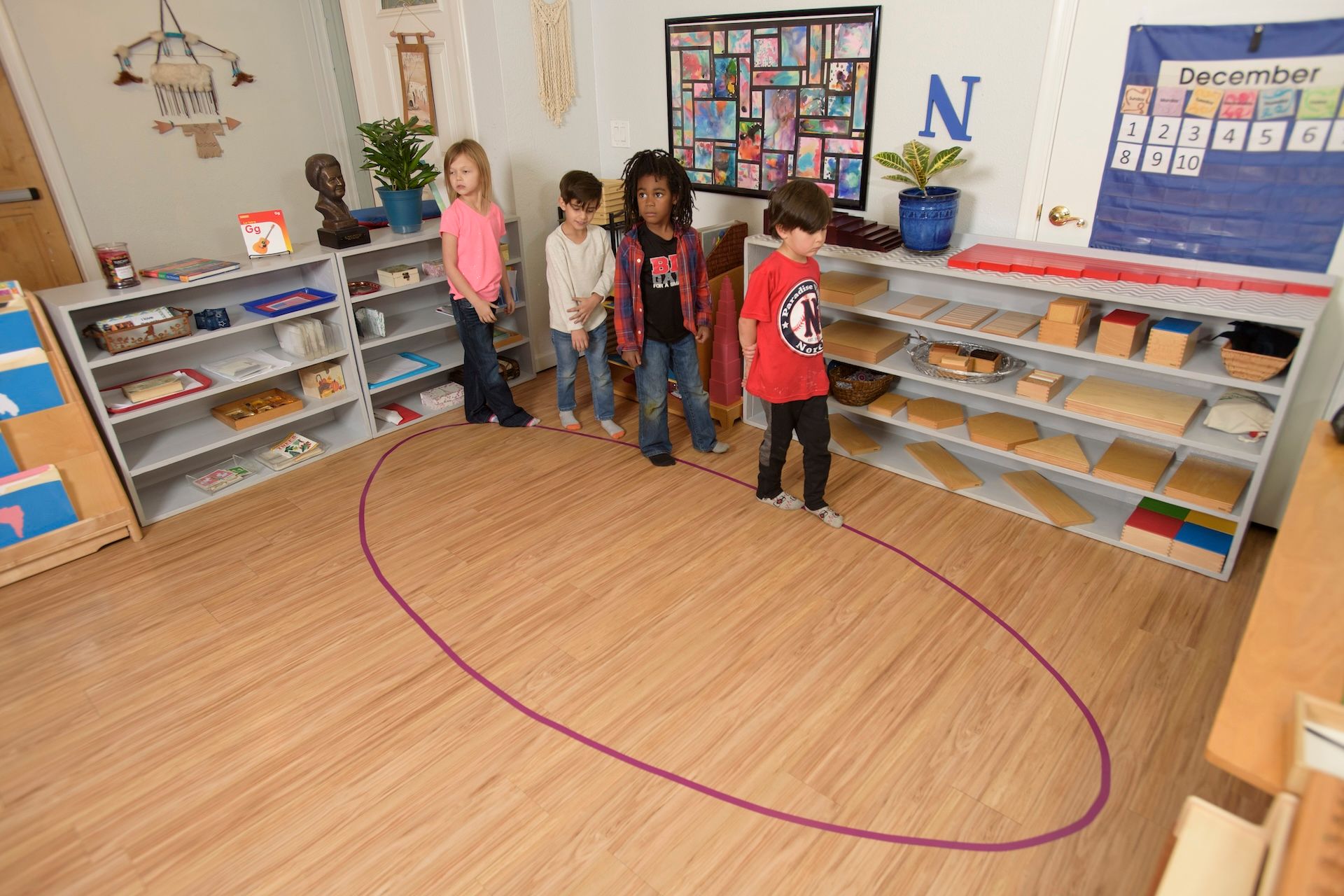
Our young children are developing their body control, concentration, and equilibrium. So in Montessori, we intentionally provide opportunities for them to practice these skills.
Dr. Maria Montessori was especially curious about helping children acquire equilibrium. She developed the “walking on the line” exercises after observing children's interest and delight in walking on curbs or along any line they could find.
What is Walking on the Line?
We first start by creating a designated place for children to practice the balance, control, and focus needed to walk along a line. The “line” is often in the shape of an ellipse and can be in the classroom, another indoor space, or even outdoors. The line can be temporary (e.g. chalked on the ground), slightly more enduring (e.g. created with fabric or electrical tape on the floor), or painted onto the surface for a more permanent line.
Walking on the line is a favorite activity and although it is mostly found in primary classrooms, elementary children also enjoy walking on the line challenges, too!
Preliminary Activities
The first activity on the line is simply walking on it with natural steps. That being said, we start with preliminary exercises to help children master small components to ensure success when multiple children are involved.
The first stage is learning how to come to the line. We introduce a signal (e.g. one drumbeat) and show children how to put their toes on the line and face towards the center when they hear that signal. Then we play a short game with the children. We might have them hop inside the line, then use the signal as an indication to come back to the line, or go for a walk and come back to the line, take a step backward and come back to the line, and so forth. All of this is to practice hearing the signal and coming to the line in the designated way.
When children can do this consistently, we may introduce another challenge. This time, with a new signal (perhaps two drumbeats), children learn how to make space so they can spread out on the line without touching their neighbors.
With this mastered, children are ready to learn how to turn to face the same direction. We often need to assist so children learn how facing the same way means looking at the back of their neighbor’s head (rather than at another student’s eyes). This new skill requires a new signal (e.g. rubbing the drum)!
Learning and practicing these various preliminary activities can take a series of days or even weeks. We take our time, rather than rushing the process, as children find delight with each component. Once they know all three signals, children love playing a game that incorporates coming to the line, making space, and turning to face the same direction.
Walking to a Beat
With these foundations in place, we introduce walking to a beat. Children know how to come to the line, space themselves out, and turn to face the same direction. Now they try to walk on the line with each step corresponding to the beat of the drum. When the beat stops, they stop. This is quite a challenge for our little ones, but also great fun.
As always, we make a game of the experience. We may offer little suggestions, or points of interest, to aid in their success. If we notice little feet moving off the line, we can suggest that children “follow the line” if. Or we may challenge them with different kinds of instructions: walk with your whole body, hold your chin up, relax your arms, or keep your body very still.
We also try to model a natural heartbeat rhythm for the children to walk to. When the beat stops, we teach the children to stop and turn to face the inside of the ellipse.
Walking with Changing Rhythms
When children are walking consistently to a beat, we let the children know we may change the beat and they can change their steps to follow the beat. We start with the natural beat, then introduce different modulations, from speeding up, coming back to a natural rhythm, slowing down, to coming back to the original beat. We always end with the natural rhythm, for it brings children back to a place of calm.
Equilibrium Exercises
With equilibrium exercises, we introduce challenges such as walking on the line heel to toe or carrying objects such as beads on a string, a container of water, an object on a tray, or a sphere on a spoon. Sometimes children try to walk carrying a bean bag on their head without the bean bag falling as they walk. As an added challenge, children can try turning their heads to the right and left.
We also introduce ways for children to adjust to a changed center of balance. In a “follow the leader” method, we start by walking with hands at our side, but then change and move them in the air, or on hips, or even hands on shoulders. While these adjustments may seem simple for adults, continuing to walk heel to toe while making these movements can take a lot of concentration and balance for our young ones!
Rhythm Exercises
When children have made good progress with their equilibrium, we can help them turn their attention to walking on the line with music. We may use the bells, tone bars, or prerecorded music, so children can walk on the line when they hear the music and stop when the music stops. We eventually introduce different types of music that inspire different types of movement, from walking to marching to galloping or skipping.
Alternating between the types of music helps children become attuned to how their movements change according to what they hear. We always end with a slow, sedate walk on the line to bring everyone’s heart rate and energy level down.
Movement as Expression
With all of the walking on the line activities, children begin to become more aware of what they can do with their bodies and as a result, develop more conscious control of their movement. Ultimately movement is an essential component of human expression.
Subscribe to our Blog
You might also like