Observation to Instruction

April 24, 2023

Do you see your child throwing their clothes on the floor in a heap? Maybe leaving things out on the kitchen table? Interrupting during mealtime?


It’s so tempting in these moments to jump in, perhaps correcting or reminding (often for what seems like the umpteenth time). 


One of the keys to a Montessori approach is taking the time to observe what is happening, noting what you see, and waiting for an opportune time to teach what to do rather than what not to do.


Supporting Undeveloped Skills


For example, a Montessori teacher saw that a child new to the classroom was regularly cutting to the front of the line as children prepared to wash their hands. Other children were getting quite upset with this young friend’s tactics to get to the front of the line. 


Instead of reprimanding the child, the Montessori teacher observed that he wasn’t acting maliciously. He just seemed to not yet have or know the skills to line up successfully. At a quiet moment, the teacher connected with the young boy and let him know that when there is a line, we just go to the end of where the line is forming. Grateful for this information on social graces, the child then happily started going to the end of the lines. It turns out the child just didn’t know the expectations!


It can be so tempting to jump in when we see something happening that we don’t like. Yet as long as children aren’t hurting others, their surroundings, or themself, we practice observing and determining what children still need to learn to be successful. 


Observation is Key


The heart of the Montessori method is learning how to observe children in an objective and meaningful way. Adults learn how to look rather than merely see. In order to look without judgment, expectation, or preference, adults work on developing a deep inner awareness. This requires that we observe to understand rather than see something and jump to conclusions. 


Thus Montessori education is focused on the natural emergence of young humans at their own pace. The role of adults is to prepare the environment and support children in their optimal development. In order to do this, we have to become constructive observers. We focus on waiting and observing, rather than intervening right away.


How This Can Work at Home


This is something that we can try at home, too. Perhaps your child is throwing their clothes on the floor in a heap. Rather than scold or lecture in the moment, try taking a deep breath and making yourself a little note to remember to circle back to the undeveloped skill. Later, when everyone is relaxed and content, take the time to connect with your child. Let them know you want to show them how to either put their clothes in the laundry basket or fold and store them for later use. Practice these options together. Finally, thank your child for taking the time with you to learn this skill. 


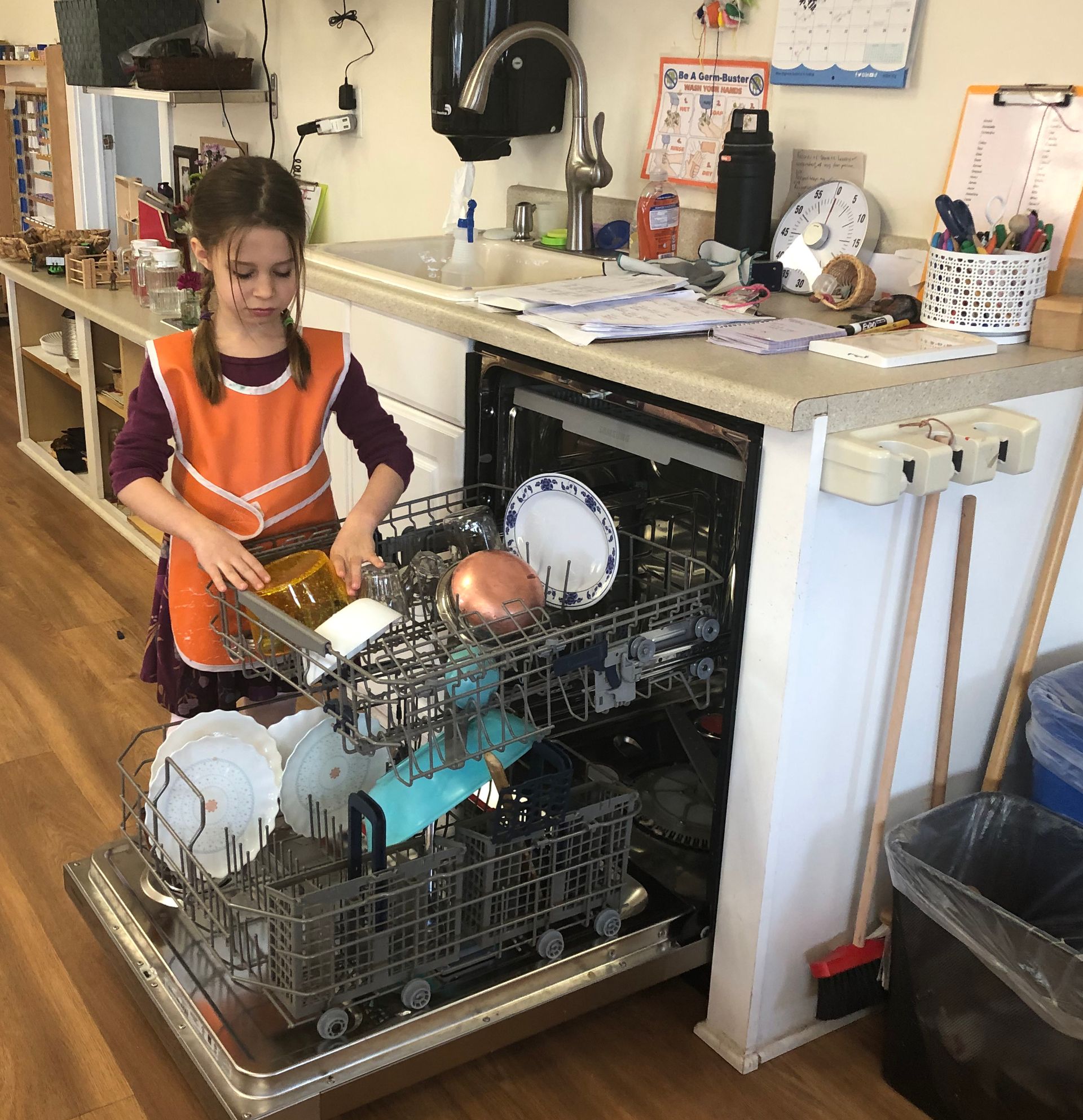
Or perhaps you can go over the steps to loading dishes in the dishwasher. Or how to wait for a pause in the conversation. The trick is to observe for the need and wait to give instructions. Children want to do well. Often they just need us to observe, pause, and later take the time to show them how to be successful. 


This doesn’t mean that our children will always remember how to do what we’ve shown. Sometimes they’ll need a smile and a gentle reminder. Sometimes they’ll need us to cycle back and demonstrate something again. The key is remembering to observe, rather than reacting in the moment. 


The Montessori Approach


Through observation, Dr. Maria Montessori discovered how children’s character is formed through experiences in the environment, how children adapt to their culture, and how children have sensitive periods for acquiring all sorts of important skills. 


Observation allows us to provide children with opportunities to become competent and capable. Come observe this for yourself! Click here to schedule a tour today!

Subscribe to our Blog

You might also like
By Danielle Giordano February 4, 2026
The body content of your post goes here. To edit this text, click on it and delete this default text and start typing your own or paste your own from a different source.
By Danielle Giordano January 30, 2026
In Montessori elementary classrooms, we like to introduce big ideas with big stories. We offer children a sense of wonder first, sort of like an imaginative doorway, so that when they later study formulas, theorems, and proofs, they already feel connected to the human story behind them. One of these stories is The Story of How Geometry Got Its Name, an introduction to a subject that is far older than the textbooks and protractors we encounter today. In Montessori, Geometry is more than about shapes. It is about human beings solving real problems in the real world. A Problem as Old as Civilization To introduce geometry, we take children about five thousand years back in time to the ancient civilization of Egypt. This was a land shaped by the , the longest river in the world. Each year, the Nile flooded its banks as snowmelt poured down from the mountains far to the south. The Egyptians depended on this yearly flood as it left behind rich, dark silt that nourished their crops and made life possible in an otherwise harsh desert. But the flood created a challenge, too. It washed away the boundary markers that separated one farmer’s field from another. When the waters receded, no one could quite remember where their land began and ended. Arguments ensued. “This corner is mine!” And the fields needed to be measured and marked again. The First Geometers: The Rope Stretchers To solve this annual problem, the Egyptians relied on a special group of skilled workers called the Harpedonaptai, or Rope Stretchers. These were early land surveyors who used a knotted rope tied at regular intervals and three weights to create a very particular triangle. In the classroom, we invite a few children to hold a prepared rope at its large knots, forming that same triangle. As they stretch it out and lay it on the ground, many quickly recognize what the Egyptians had unknowingly created: a scalene right-angled triangle. This shape would later become central to the geometry studied by Greek mathematicians. The Rope Stretchers used this simple tool to re-establish field boundaries, set right angles, and make sure the land was measured accurately and fairly. Geometry, in its earliest form, served a deeply practical purpose. From Rope to Pyramid The Rope Stretchers’ expertise was valued far beyond the farmlands. They also helped lay out the foundations of temples, monuments, and even the Great Pyramid of Giza. The base of the Great Pyramid is a perfect square, which is an astonishing feat of measurement and design. The Pharaoh himself oversaw these measurements, but it was the Rope Stretchers who executed them. Their work represents one of humanity’s earliest recorded sciences: the careful measuring of the earth. How Geometry Got Its Name The name geometry reflects this ancient practice. It comes from two Greek words: gê — earth metron — measure Geometry literally means earth measurement. The Egyptians did not use the language of right angles, nor did they classify triangles as we do today. Their work was grounded in practical needs. They needed to solve problems, organize land, and create structures that would endure for thousands of years. Yet their discoveries influenced later thinkers like Pythagoras, who likely traveled to Egypt and learned from their methods. Over time, the simple knotted rope inspired a whole discipline devoted to understanding lines, angles, shapes, and the relationships between them. Why We Tell This Story in Montessori When Montessori children hear this story, something important happens. Geometry becomes more than a set of rules or vocabulary words. It becomes a human endeavor born from curiosity, necessity, and ingenuity. This is the heart of Montessori’s cosmic education: helping children see knowledge not as isolated subjects, but as gifts from generations before them. When children pick up a ruler, explore angles with a protractor, or classify triangles in the classroom, they are continuing a legacy that began with those early Rope Stretchers on the banks of the Nile. Through story, children feel connected to the people who shaped our world and to the problems that inspired great ideas. Schedule a tour today to see how geometry becomes meaningful, purposeful, and alive for our children here in Old Saybrook, CT.
Gratitude: Why We Celebrate the Unsung Heroes
November 25, 2024
As elementary children admire heroes, Montessori uses this to inspire leadership, cooperation, and appreciation for both known and unknown heroes.
More Posts