
Establishing the Flow: Your Guide to a School Year Started Off Right

It’s that time of the year again. Over the course of the summer, and even with the best of intentions, some of our routines tend to dissolve and give way to relaxation and adventures. Which is great!
The school year is starting soon. Now is the perfect time to consider what your family will do to prepare for the transition back.
Unless this is your child’s first year heading to school, you’ve probably been through and considered all this before, but it’s always nice to have a little refresher. Read on for our tips to make the start of the school year as smooth as possible for everyone.
Sleep
Perhaps the most important bit to consider, your child’s sleep schedule is critical to their success. There are three elements to focus on: how much sleep your child needs, when that sleep should take place, and the quality of sleep.
So just how much sleep does your child need? It depends on the individual, but age plays an important role.
Here are the AAP's recommendations on how much sleep children should get within each 24 hour period. (Times include naps.)
| 4 months - 1 year | 12 - 16 hours |
|---|---|
| 1 - 2 years | 11 - 14 hours |
| 3 - 5 years | 10 - 13 hours |
| 6 - 12 years | 9 - 12 hours |
| 13 - 18 years | 8 - 10 hours |
Once you know how much sleep your child should be getting, and what amount works best for them, figuring out bedtime is as simple as counting back, considering factors like when you need to leave in the morning and how long it takes to get ready.

Is their desired bedtime nowhere near their current bedtime? Take the transition slowly. Start by having them go to sleep just 15 minutes earlier, then another 15 minutes earlier every few days until you reach your goal.
As for quality of sleep? That’s all about creating a relaxing environment. A darker, cool room works best, and establishing a regular and soothing bedtime routine will help them drift off to dreamland easier. Keep the routine the same each night, whether that includes a warm bath, reading, or even using a little lavender-scented spray.
Schedule
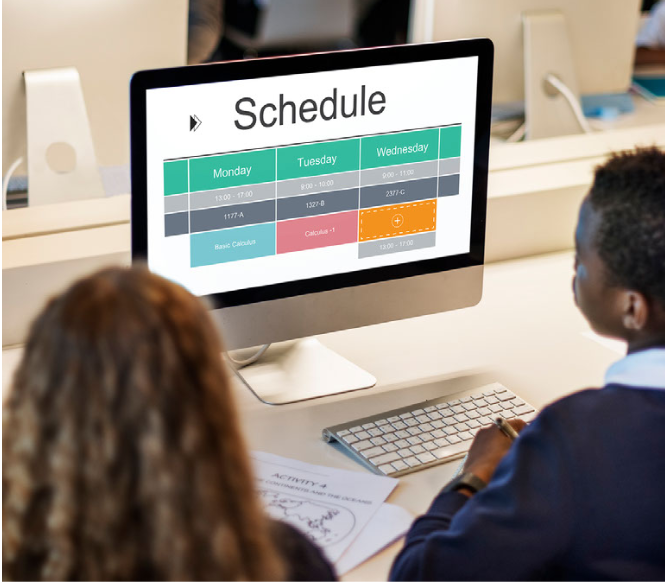
We touched on this above, but creating a regular schedule is really important. When children know what to expect, they are much better equipped to take on the day. There will certainly be moments and days when routines are interrupted, but if we prioritize them most of the time, children benefit greatly.
Every family is different, but consider what you want your morning to look like. Some questions that will help guide you in creating a schedule:
- What time should you leave the house to arrive comfortably at school/work?
- What tasks could be done ahead of time (perhaps the night before) to alleviate the morning rush?
- What is your child able to do independently, and what will they need help with?
The same basic concept goes for evening routines as well. As we mentioned in the section on sleep, a focus on calming rituals prepares your child’s mind and body for a restful night of sleep. If the steps remain the same night after night, bedtime will only become easier as the weeks pass by.
Emotions
It is totally normal for children (and even adolescents) to experience big emotions as back-to-school approaches. They may feel excited, anxious, apprehensive about being apart from you, as well as a wide range of other thoughts and feelings.
If your child feels distraught at all, it can be really hard for parents to see. For some of us, the natural reaction is to do whatever we can to minimize the concerns and help them move on. The very best thing we can do, however, is to acknowledge their feelings. When you notice behavior that is reflective of emotional tension, ask them how they’re feeling. If they’re very young, help them name their emotions. Acknowledge that these are normal ways to feel.
Validation is key here. Should we ease their fears a bit by talking about what to expect and addressing their concerns? Of course! But those talks may not erase their worries, and that’s okay. Let them know you recognize their emotions and that it’s okay to feel however they feel.
Parents can experience overwhelming emotions at this time, too. You may surprise yourself! If you’ve been able to spend extra time with your child all summer long, the thought of so much time apart can be hard (or not). Perhaps your child is starting in a new class or is beginning their final year and it has you thinking about how quickly they are growing up. Think of it as a great way to model what to do in the face of challenging feelings.
Expectations
Even with careful planning and the best of intentions, nothing ever goes quite as planned, especially when it comes to our children. Maybe the first day of school is creeping closer and you’re still struggling to get the kids into bed before 9:00. Maybe your eight-year-old is super nervous about starting at a new school. Maybe it’s a challenge to balance your own work schedule with morning drop-off.
Whatever you do, expect the unexpected. Know that we are here to support the children and families in our community. The first couple of weeks at school may be bumpy, they may be smooth, or (most likely) they’ll be somewhere in between. We hope you and your child are looking forward to the start of a new year, and we can’t wait to see you all again!
Subscribe to our Blog
You might also like