An Expansive Experience: Music in Montessori
May 27, 2024

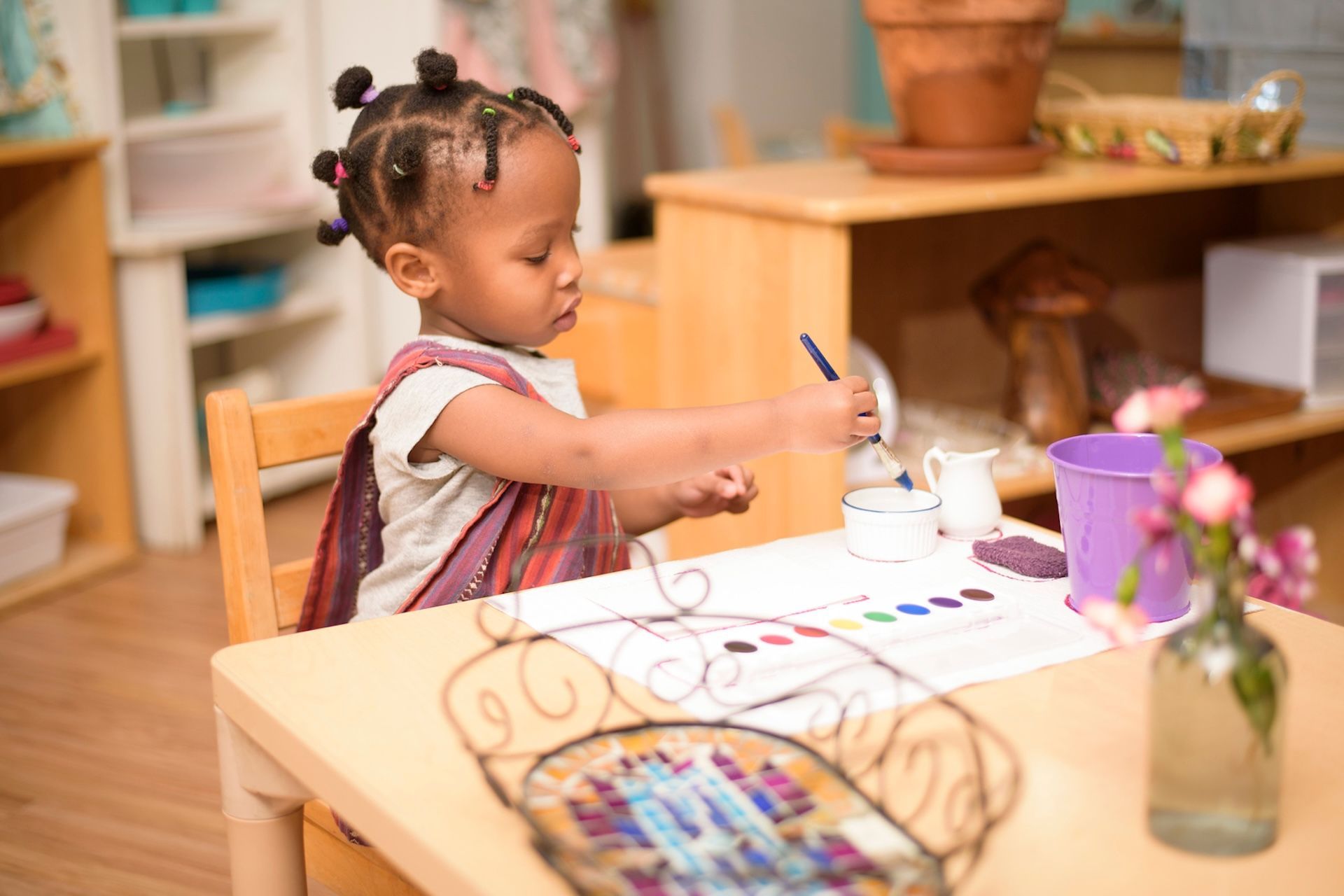
In Montessori, music is both interwoven into the curriculum and its own area of study. Like with the other subjects in Montessori, music begins sensorially, isolates difficulty through key lessons, and engages children in spontaneous forms of expression.

Sensorial & Connected Experiences


In our toddler and primary classrooms, we first offer sensorial experiences and impressions related to music. We encourage listening and awareness, perhaps hearing the snap of the snaps of the dressing frame or noticing the delicacy of the sound when placing a glass vase on a tray. The sound cylinders also help children distinguish fine gradations of softness and loudness. In the Silence Game, children become attuned to the many types of sounds around them when they sit quietly and listen.


Children are also able to link music and movement through the rhythm work in walking on the line activities, as well as simple activity rhymes, chants, and a wide repertoire of songs. In fact, we sing with the children every day because singing together is a powerful community builder!


We also offer children opportunities to listen to the music of various cultures. They love the challenge of identifying instruments by the sounds that they make, too. 


Keys to Music


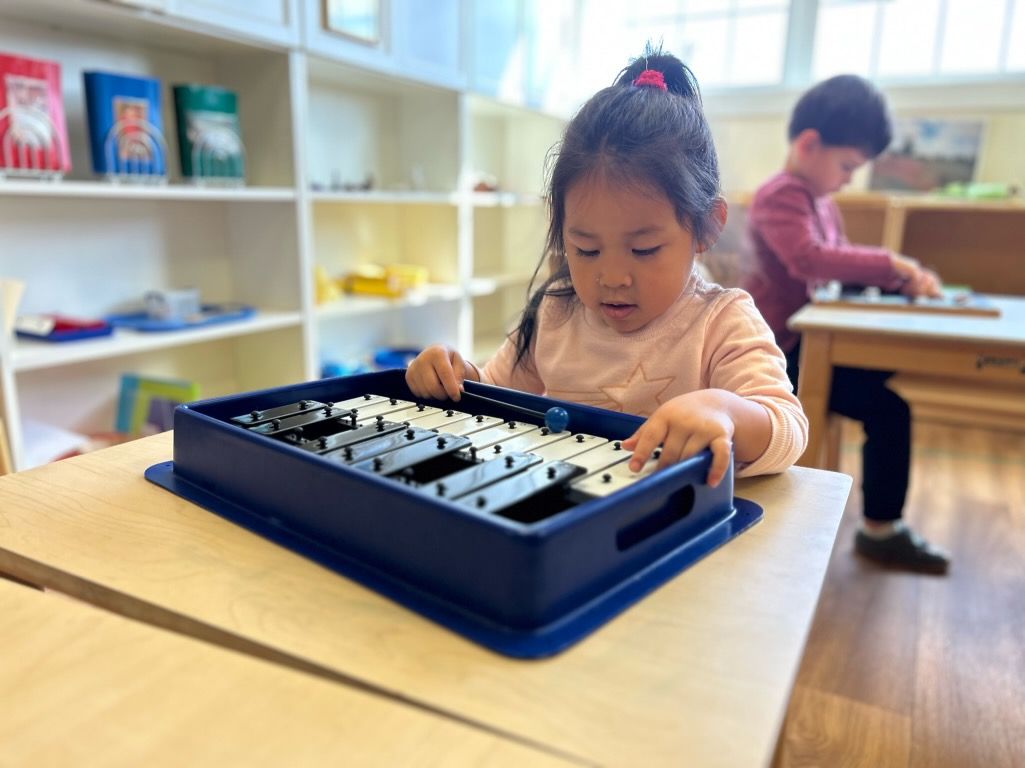
We use the bells in our primary programs, and the tone bars in our elementary classrooms, for music literacy (the reading, writing, and playing of music), as well as music theory, including notes, scales, chords, rhythm, melody, harmony, and form.


With the lovely Montessori bells, children begin to discriminate pitch by first playing individual bells, and then pairing and grading according to pitch. Next, they move on to naming the pitches and matching the pitches with their notes. Eventually, children learn the placement of the notes on the musical staff, as well as how scales and melodies can be written with notes on the staff.


In elementary classrooms, the work continues with the tone bars, as children learn about the degrees of the scale, intervals, the sequence of major scales with sharps and flats, key signatures, transposition, and the naming and notation of minor scales. 


In Montessori, music is not a separate subject, only to be taught in a separate room by a specialist teacher. We want music to be an integral part of the daily life in the learning environment. As such, the Montessori music program provides keys to music that can be presented by any trained Montessori teacher regardless of musical background.


A Form of Language 


Ultimately, music is a language of communication. Because music is a language, we think about music development as we do children’s language development and honor both the “spoken stage” and “written stage.” 


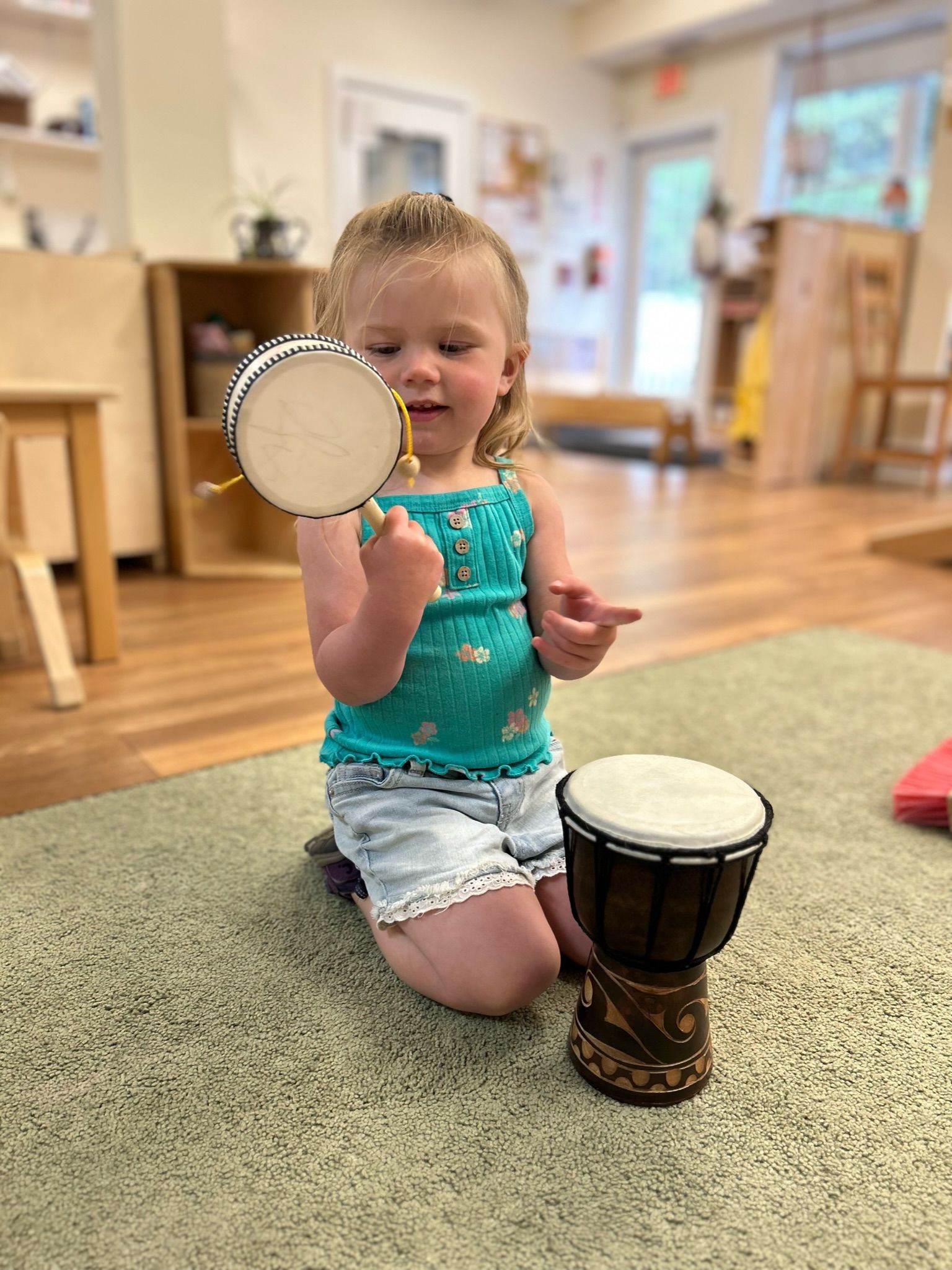
Within the spoken stage, we may observe children picking away at bells or tone bars, striking notes without any apparent purpose. We treat this activity with respect as it represents the babbling stage of music. 


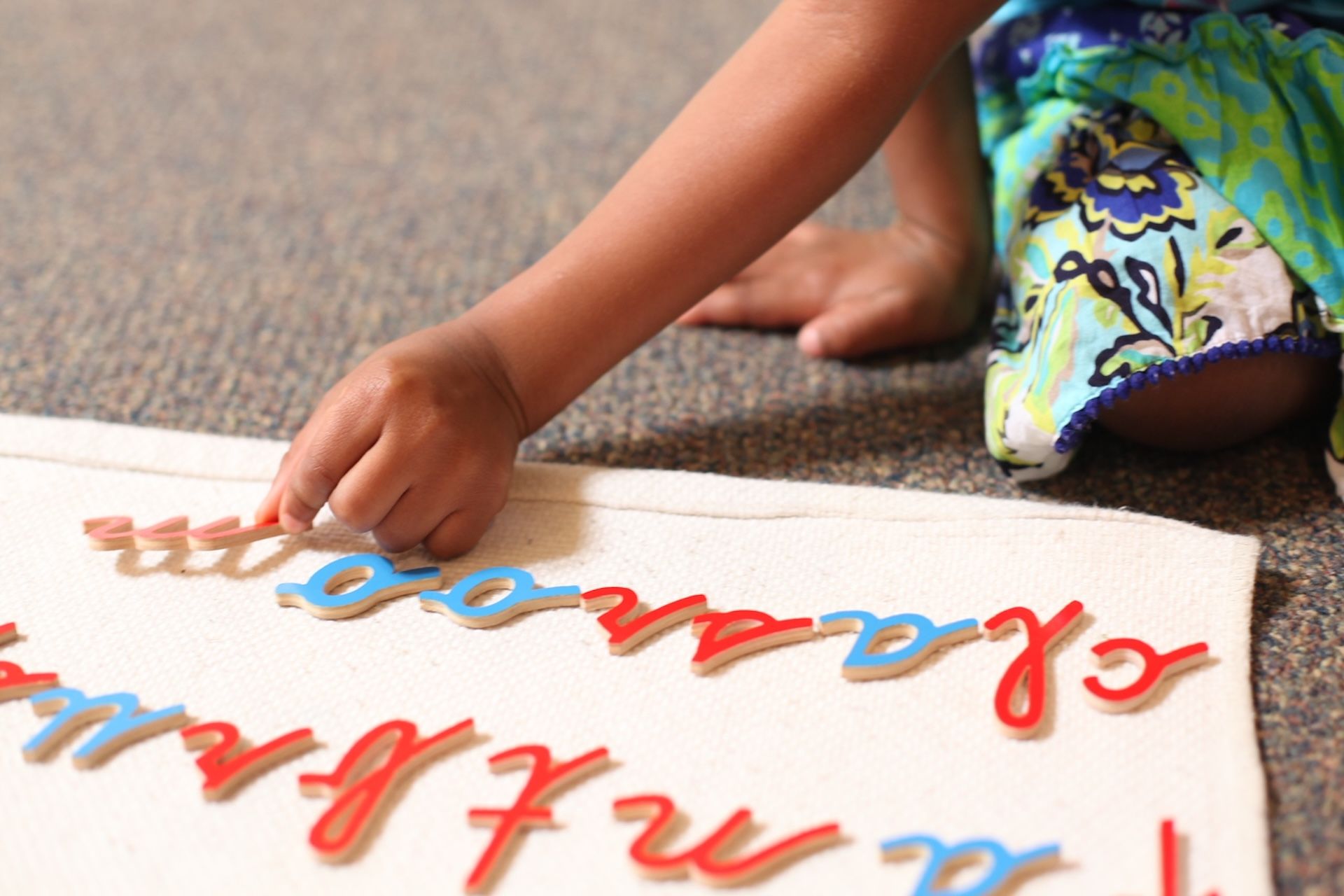
The children eventually sing and play (on the Montessori’s bells and tone bar materials, as well as other instruments) and later they write and read music. Just like with the moveable alphabet for language, children can use a moveable alphabet for music notation to be able to write their own compositions. At this point, we often see children explode into music performance and notation, just as they explode into writing and reading.


While the bells and tone bars are used for many purposes, including work with music notation, they are first and foremost musical instruments and children love incorporating songs into classroom performances and sharing.


Expansive Program


In our primary and elementary communities, the music program is vast and includes music appreciation and history, singing, movement/dance, rhythm, pitch, intensity, timbre, form, style, listening, instrumental work, music theory, and the science behind the music. 


By isolating difficulties and providing various preparation of skills, even our young children come to extemporaneous and spontaneous composition.


Music is part of culture and thus we want to ensure that our children have contact with the world of music. The future musicians among them will connect to their life’s path and their life’s work at an early age! Even those who don’t go on to study music develop an appreciation for and understanding of this important part of human culture. 


Subscribe to our Blog

You might also like
By Danielle Giordano January 30, 2026
In Montessori elementary classrooms, we like to introduce big ideas with big stories. We offer children a sense of wonder first, sort of like an imaginative doorway, so that when they later study formulas, theorems, and proofs, they already feel connected to the human story behind them. One of these stories is The Story of How Geometry Got Its Name, an introduction to a subject that is far older than the textbooks and protractors we encounter today. In Montessori, Geometry is more than about shapes. It is about human beings solving real problems in the real world. A Problem as Old as Civilization To introduce geometry, we take children about five thousand years back in time to the ancient civilization of Egypt. This was a land shaped by the , the longest river in the world. Each year, the Nile flooded its banks as snowmelt poured down from the mountains far to the south. The Egyptians depended on this yearly flood as it left behind rich, dark silt that nourished their crops and made life possible in an otherwise harsh desert. But the flood created a challenge, too. It washed away the boundary markers that separated one farmer’s field from another. When the waters receded, no one could quite remember where their land began and ended. Arguments ensued. “This corner is mine!” And the fields needed to be measured and marked again. The First Geometers: The Rope Stretchers To solve this annual problem, the Egyptians relied on a special group of skilled workers called the Harpedonaptai, or Rope Stretchers. These were early land surveyors who used a knotted rope tied at regular intervals and three weights to create a very particular triangle. In the classroom, we invite a few children to hold a prepared rope at its large knots, forming that same triangle. As they stretch it out and lay it on the ground, many quickly recognize what the Egyptians had unknowingly created: a scalene right-angled triangle. This shape would later become central to the geometry studied by Greek mathematicians. The Rope Stretchers used this simple tool to re-establish field boundaries, set right angles, and make sure the land was measured accurately and fairly. Geometry, in its earliest form, served a deeply practical purpose. From Rope to Pyramid The Rope Stretchers’ expertise was valued far beyond the farmlands. They also helped lay out the foundations of temples, monuments, and even the Great Pyramid of Giza. The base of the Great Pyramid is a perfect square, which is an astonishing feat of measurement and design. The Pharaoh himself oversaw these measurements, but it was the Rope Stretchers who executed them. Their work represents one of humanity’s earliest recorded sciences: the careful measuring of the earth. How Geometry Got Its Name The name geometry reflects this ancient practice. It comes from two Greek words: gê — earth metron — measure Geometry literally means earth measurement. The Egyptians did not use the language of right angles, nor did they classify triangles as we do today. Their work was grounded in practical needs. They needed to solve problems, organize land, and create structures that would endure for thousands of years. Yet their discoveries influenced later thinkers like Pythagoras, who likely traveled to Egypt and learned from their methods. Over time, the simple knotted rope inspired a whole discipline devoted to understanding lines, angles, shapes, and the relationships between them. Why We Tell This Story in Montessori When Montessori children hear this story, something important happens. Geometry becomes more than a set of rules or vocabulary words. It becomes a human endeavor born from curiosity, necessity, and ingenuity. This is the heart of Montessori’s cosmic education: helping children see knowledge not as isolated subjects, but as gifts from generations before them. When children pick up a ruler, explore angles with a protractor, or classify triangles in the classroom, they are continuing a legacy that began with those early Rope Stretchers on the banks of the Nile. Through story, children feel connected to the people who shaped our world and to the problems that inspired great ideas. Schedule a tour today to see how geometry becomes meaningful, purposeful, and alive for our children here in Old Saybrook, CT.
Gratitude: Why We Celebrate the Unsung Heroes
November 25, 2024
As elementary children admire heroes, Montessori uses this to inspire leadership, cooperation, and appreciation for both known and unknown heroes.
Nurturing the Whole Child: How Montessori Balances Emotional, Social, and Cognitive Growth
November 18, 2024
Montessori nurtures the whole child, balancing academics, social-emotional learning, conflict resolution, and community-building in a prepared environment.
More Posts